Coins
Standard Chartered Cuts Ethereum Price Target by 60%, Now Predicts $4K by Year-End
Standard Chartered has slashed its Ethereum (ETH) price target by 60%, forecasting $4,000 by year-end. Find out what’s driving the downgrade.


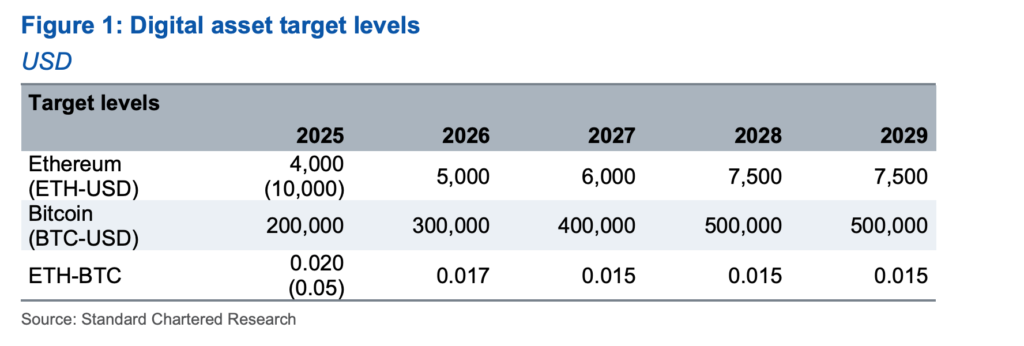
Standard Chartered has significantly revised its ETH price target, cutting its previous projection by 60% and now forecasting that ETH will reach $4,000 by the end of 2025. This sharp downgrade reflects changing market dynamics and evolving expectations for Ethereum’s role in the broader crypto ecosystem.
ETH Price Target Slashed Amid Market Shifts
According to their recent report, Standard Chartered’s latest report drastically reduces its earlier bullish ETH forecast. The bank had previously predicted Ethereum could surpass $10,000, but has now readjusted its target, citing weaker-than-expected market conditions and shifting institutional interest in digital assets.
Despite the revised projection, ETH remains one of the strongest-performing cryptocurrencies, with continued interest in Ethereum-based DeFi applications and staking mechanisms. However, analysts believe competition from alternative blockchain networks and macroeconomic factors have tempered Ethereum’s growth outlook.
Why Standard Chartered Lowered Its ETH Forecast
Several key factors contributed to the 60% reduction in ETH’s projected price target:
- Regulatory Uncertainty: Increasing global regulatory scrutiny on Ethereum staking and DeFi protocols has raised concerns about potential restrictions impacting ETH’s long-term value.
- Market Volatility: The broader crypto market downturn and fluctuations in Bitcoin’s price movements have influenced Ethereum’s price trajectory.
- Competition from Layer 1 and Layer 2 Networks: Rival blockchain ecosystems, such as Solana, Avalanche, and Polygon, continue to grow, posing challenges to Ethereum’s dominance.
Despite these challenges, Ethereum’s fundamentals remain strong, with continued developments in its ecosystem, including scalability improvements through layer 2 rollups and future upgrades to the Ethereum network.
Can Ethereum Still Reach $4,000 by Year-End?
While Standard Chartered’s revised target is a downgrade, a $4,000 ETH price by the end of 2025 still represents significant upside potential from current levels. Ethereum’s growth trajectory will depend on:
- The adoption of Ethereum’s blockchain for institutional finance and enterprise use cases.
- The impact of upcoming Ethereum network upgrades focused on scalability, security, and energy efficiency.
- Broader macroeconomic trends, including interest rates and risk sentiment in global financial markets.
Market analysts suggest that if ETH can maintain its position as the leading smart contract platform, the $4,000 target remains achievable, though uncertainties around regulation and competition could impact future growth.
Conclusion
Standard Chartered’s decision to slash its Ethereum price target by 60% reflects a more cautious market outlook but still acknowledges ETH’s long-term potential. With network developments, institutional interest, and DeFi growth, Ethereum remains a key player in the crypto landscape, though investors should remain mindful of regulatory and competitive risks.

Polygon has announced a major new vision that could redefine how money moves globally. In a fresh update shared today, Sandeep Nailwal, Founder of Polygon, along with Marc Boiron, CEO of Polygon Labs, introduced what they call the Polygon Open Money Stack.
The idea behind the announcement is simple but ambitious: money should move as freely as information does on the internet. According to Polygon, today’s payment systems are outdated, slow, and expensive and blockchain finally offers a better alternative.
Why Payments Are Polygon’s Focus
Polygon believes that stablecoin-based payments are the first real-world blockchain use case that is clearly better than traditional systems. Legacy payment rails often involve delays, high fees, and uncertainty, especially for cross-border transfers.
Stablecoins, on the other hand, allow value to move instantly, globally, and at a much lower cost. Polygon sees this as the fastest-growing blockchain use case and one where it already has a strong advantage.
Over the past six years, Polygon has focused heavily on real-world adoption. The network has been used by major global companies and financial institutions, including Stripe, JP Morgan, BlackRock, Mastercard, HSBC, and others. During this time, Polygon has facilitated more than $2 trillion in onchain value transfers.
What Is the Polygon Open Money Stack?
The Open Money Stack is a vertically integrated system designed to handle every part of onchain money movement. Instead of relying on multiple providers, businesses will be able to access everything through one simple integration.
The stack includes blockchain rails, stablecoin orchestration, wallet infrastructure, fiat on-ramps and off-ramps, cross-chain movement, compliance tools, onchain identity, and yield opportunities. It will support any chain, offer shared or dedicated blockspace, and make onboarding users from both fiat and crypto easier.
Cross-chain movement will be powered by Polygon’s interoperability layer, Agglayer, allowing money to move seamlessly across different blockchains.
A Generational Opportunity for Polygon
Polygon says this moment represents a “zone of genius” for the network. While moving all global money onchain could take a decade or more, the company believes the next three years will define the winners in this space.
With the Open Money Stack, Polygon aims to create an open, reliable, and global system that institutions, businesses, and users can trust bringing money fully onchain and making it faster, simpler, and more useful than ever before.
XRP appears positioned for a potential rebound after forming a bullish engulfing pattern on its daily chart, a classic technical signal that buyers may be stepping back in. This comes alongside notable shifts in exchange supply and ongoing institutional interest, suggesting improving sentiment for the Ripple.
Market Context & Price Action
At press time, XRP was trading around $1.88, showing resilience near key support levels despite recent market volatility. This price level resonates with broader charts showing consolidation and stabilization following earlier downturns.
The bullish engulfing pattern where a large green candlestick fully covers the prior red candle often indicates a shift from selling pressure to renewed buying interest. Technical analysts view this as one of the more reliable reversal signals when occurring near established support zones.
Exchange Reserves Decline
A key driver behind the upbeat narrative is the continued decline in XRP supply on exchanges, especially on Binance, the world’s largest crypto venue by trading volume. Third-party on-chain data show exchange balances dropping to multi-month lows, suggesting that holders are moving XRP off exchanges and potentially into long-term storage. This pattern is generally interpreted as accumulation rather than readiness to sell.
Declining exchange reserves can reduce sell pressure and provide a structural tailwind if demand begins to outpace available supply.
Strong ETF Inflows Contrast Broader Market Weakness
Institutional interest is also making headlines. Spot XRP exchange-traded funds (ETFs) reported over $68 million in net inflows this week, bringing the cumulative total above $1 billion. Interestingly, this demand surge comes at a time when Bitcoin and Ethereum ETFs have been experiencing outflows, underscoring a potential structural appetite among institutional allocators for XRP exposure.
Technical Signals
Beyond the bullish engulfing candle, XRP’s chart also shows other reversal cues, including an inverse head-and-shoulders formation, another technical structure associated with downward exhaustion and potential trend flip.
However, not all signals are unambiguously bullish. Broader market analysis from independent data sources notes that XRP remains within a defined range and must decisively reclaim and hold levels above key resistance (near the $2.00 mark) to confirm a stronger uptrend.
What Traders Are Watching
Bullish catalysts:
- Strong on-chain accumulation and shrinking exchange reserves
- Continued spot ETF inflows
- Bullish engulfing and reversal chart patterns
Risks & cautionary factors:
- XRP still trading below recent resistance levels
- Mixed broader market technicals, with some analysts warning of breakdown risks if key support fails
- Potential pressure from recent leveraged positions and liquidity trends in certain trading venues
Bottom Line:
XRP’s recent chart action and on-chain dynamics have injected fresh optimism among traders and analysts. While the bullish engulfing setup and institutional flows suggest a possible near-term rebound, decisive confirmation above critical resistance levels will be essential for a sustained move higher.
Chainlink (LINK) is back in the spotlight after rising 2% in the last 24 hours, matching the strong momentum it has shown over the past week with an 8.1% gain. The overall crypto market moved only slightly (+0.13%), but LINK stood out thanks to a mix of upbeat ETF news, technical strength, and major buying by large investors.
The biggest boost came from the launch of the first-ever U.S. Chainlink ETF, which opened the doors for more traditional investors to gain exposure to LINK. Alongside this, technical charts showed improving momentum, while on-chain data revealed heavy accumulation by whales ahead of the ETF debut. Together, these factors helped LINK climb even as the broader market stayed cautious.
First U.S. Chainlink ETF Launch Draws Strong Demand
The biggest story driving LINK’s move is the debut of Grayscale’s spot Chainlink ETF (GLNK), which began trading on NYSE Arca on December 4. The ETF pulled in an impressive $41.5 million in its first day, showing strong early demand. It directly holds LINK, meaning every dollar invested translates to real buying pressure on the token.
Market analysts called the ETF launch a major milestone. Bloomberg’s Eric Balchunas described the early trading volume—around $13 million on day one—as an “insta-hit,” noting that it shows healthy liquidity for a brand-new product.
Why does this matter?
ETFs make it easier for institutions and traditional investors to buy crypto without holding the tokens themselves. This usually leads to increased demand, as seen when Bitcoin ETFs helped drive prices higher earlier this year.
What investors are watching now:
- Whether GLNK continues to attract inflows in the coming days
- The outcome of Bitwise’s application for another Chainlink ETF
- How much long-term demand institutional investors show for LINK as an asset
Technical Breakout Shows Promise, but Resistance Looms
On the technical side, LINK has also made progress. It recently moved above important price levels such as the 50-day simple moving average (SMA) around $14.19. Traders see this as a sign of positive momentum.
The token also reclaimed the 50% Fibonacci retracement level at the same price, showing strength after rebounding nearly 30% from its November lows.
However, LINK has hit a wall near $14.63, which remains a key resistance level. The Relative Strength Index (RSI) is around 68, signaling strong buying but also warning that the market may be getting overheated.
If LINK closes above $14.63, it could push toward the next target at $15.52. But if it drops below $14.19, analysts say some traders may start taking profits, especially after the recent rally.
Whales Scoop Up 4.73M LINK Before ETF Launch
Another major factor supporting the price is aggressive buying from whales—wallets that hold huge amounts of crypto.
Data shows that whales accumulated 4.73 million LINK worth around $68 million in the 48 hours leading up to the ETF launch. This type of buying reduces the available supply on exchanges and often pushes prices higher.
Exchange reserves of LINK have fallen to multi-month lows, meaning fewer tokens are available to sell. Chainlink’s own Reserve also purchased 109,663 LINK (worth about $1.6 million) using protocol revenue, further tightening supply.
However, traders should watch out for possible profit-taking near $15, where a large number of holders are sitting at breakeven and may choose to sell.
Conclusion
Chainlink’s recent rise is powered by a strong combination of factors: excitement around the first U.S. Chainlink ETF, improving technical indicators, and heavy whale accumulation. Together, these have given LINK a clear advantage over the broader crypto market this week.
But the next test is crucial. The $14.63–$15 range remains a big resistance zone, and the question now is whether LINK can break through and turn this short-term momentum into a longer-term trend.
Investors will be watching two key signals:
- Whether the new GLNK ETF continues to see steady inflows
- Whether LINK can close December above its 200-day SMA at $17.81, which would indicate a major shift in long-term sentiment
For now, the buzz around Chainlink is stronger than it has been in months—and the market is responding.